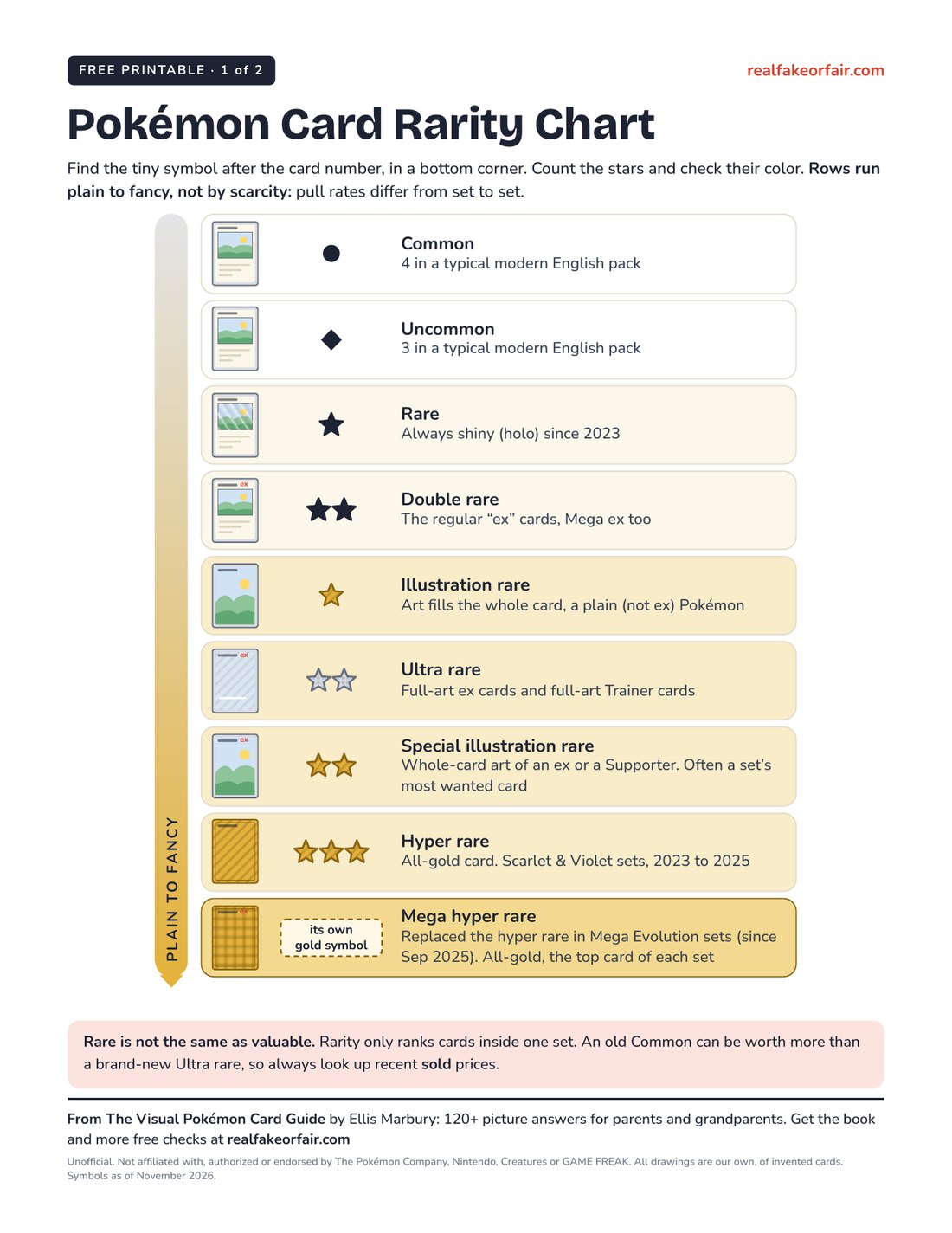
The rarity symbols, plain to fancy
| Symbol | Rarity and what the card looks like | In words |
|---|---|---|
| Common 4 in a typical modern English pack | a black circle | |
| Uncommon 3 in a typical modern English pack | a black diamond | |
| Rare Always shiny (holo) since 2023 | one black star | |
| Double rare The regular “ex” cards, Mega ex too | two black stars | |
| Illustration rare Art fills the whole card, a plain (not ex) Pokémon | one gold star | |
| Ultra rare Full-art ex cards and full-art Trainer cards | two silver stars | |
| Special illustration rare Whole-card art of an ex or a Supporter. Often a set’s most wanted card | two gold stars | |
| Hyper rare All-gold card. Scarlet & Violet sets, 2023 to 2025 | three gold stars | |
| its own gold symbol | Mega hyper rare Replaced the hyper rare in Mega Evolution sets (since Sep 2025). All-gold, the top card of each set | its own gold symbol |
Symbols as of November 2026, for today's Scarlet & Violet and Mega Evolution cards. Rows run plain to fancy, not by scarcity: the odds of pulling each one differ from set to set. No symbol at all? Basic Energy has none, and neither do a few special cards, so look the card up.
Where is the rarity symbol?
Look at the bottom corner of your card, right after the card number (for example 012/198). The small black or colored shape right after it is the rarity symbol. A stamp on the picture is something else: some promos keep their normal symbol and add a stamp, and the old "1st Edition" stamp marks an early print run, not a rarity.
Rare is not the same as valuable
Rarity only ranks cards inside one set, so an old Common can be worth more than a brand-new Ultra rare. What your card is worth depends on how many buyers want it and on its condition, so always check recent sold prices, not asking prices.
Older cards: one star, many meanings
Until March 2023 there were only a few symbols, and one star could stand for many kinds of card. Names ending in ex, EX, GX, V, VMAX or VSTAR were the big cards of their day. Check the border and the copyright line first to date the card.
Bigger number than the set? A secret rare
If the first number is bigger than the second, like 205/198, the card is numbered past the set's main list: collectors call it a "secret rare". That alone doesn't mean a misprint or a fake. The first one came out in 2000.
Want every answer in pictures?
The Visual Pokémon Card Guide covers rarity, value, fakes and fair trades for parents and grandparents who don't play: 130 pages, 120+ diagrams.